

Sponsored by the Greater Kansas City Chapter of the American Guild of Organists
Described by Fanfare magazine as a “complete musician, totally adept and utterly stylish in everything she plays,” Anne Laver is active as concert organist, scholar, and pedagogue. She has performed in the United States, Europe, Scandinavia, and Africa and has been a featured recitalist at conventions of the American Guild of Organists, the Organ Historical Society, and the Göteborg International Organ Academy (Sweden). In 2010, she was awarded second prize in the AGO National Young Artist Competition in Organ Performance. Anne’s debut recording, “Reflections of Light” (Loft, 2019) has been aired on nationally syndicated radio programs, including WXXI FM’s With Heart and Voice and American Public Media’s Pipedreams. She will release a new album of solo and chamber music for organ by composer Natalie Draper on the Acis label in early 2026.
Anne is passionate about advocacy for the organ and the encouragement of young organists. In her appointment as Associate Professor of Organ and University Organist at Syracuse University’s Setnor School of Music, she helps educate the next generation of organists and church musicians. She has been able to involve students in many facets of her current projects, such as workshops for composers who want to write for the organ, scholarship around organ music at the nineteenth and twentieth century world’s fairs, and a new documentary film about organ culture in the United States.
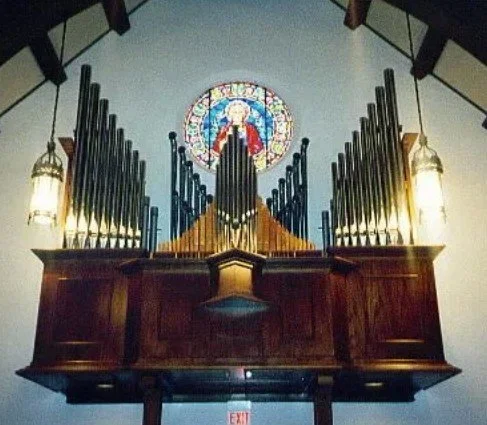
St. Andrew's Episcopal Church
Quimby Pipe Organs, Inc. Opus 37 ca. 1993 (Rebuild)
4M/P Electropneumatic action; 6 divisions, 78 stops, 49 registers, 65 ranks 3640 pipes; 2219 pipes retained from original Aeolian-Skinner Opus 1411 1960. Manual compass 61 notes, Pedal compass 32 notes.
Click here for organ specifications.

Chapter Dinner
There will be a chapter dinner for AGO members preceding this concert at 6:00 pm.
Reservations must be placed by Monday, March 2nd
Click here for reservations.
Program
“Heroes and Saints”
Pièce Héroïque, from Trois Pièces César Franck (1822—1890)
Three Preludes and Fugues, Op. 16 Clara Schumann (1819—1896), arr. Laver
I. Prelude and Fugue in G Minor
II. Prelude and Fugue in B-flat Major
Three Meditations for Organ (2020) Natalie Draper (b. 1985)
I. Alleluia
II. Prayer
III. Amen
Improvisation on “We Shall Overcome” (2011) Carl Haywood (b. 1949)
“America, the Beautiful” from Eleven Organ Solos Calvin Hampton (1938—1984)
Fugue in E-flat Major “St. Anne,” BWV 552/ii Johann Sebastian Bach (1685—1750)
Hózhó (2022) Connor Chee (b. 1987)
Étude Héroïque, Op. 38 (2012) Rachel Laurin (1961—2023)
Notes on the program
Who comes to mind at the mention of the word hero? Superman, the Avengers? Renowned warriors or leaders? Perhaps someone who shows great courage in the face of adversity?
Today’s program explores the concept of heroism through music. The following pieces connect to this theme in various ways, some of them overt, some more subtle. I hope this concert allows you to enjoy the stories of heroes and saints of old, and contemplate what it means to be a hero in our own time.
Cesar Franck premiered his Pièce héroïque at the 1878 Paris Exhibition Universelle on the large organ in the Palais du Trocadéro built by Aristide Cavaillé-Coll. The Trocadéro site was named for a battle in Spain that the French had won in the 1820s. Franck’s piece seems to tell a story of struggle. The opening theme in B minor is brooding and sinister. Halfway through the piece a new theme in B major is introduced in a lyrical, sweet texture. The two battle it out to a thrilling climax.
Clara Schumann is one of my heroes. A virtuoso pianist and a brilliant musician and composer, she found a way to forge a musical career in a time when women were discouraged from any kind of professional pursuits. After an intense childhood under a manipulative father, Clara married the composer Robert Schumann, who encouraged her to continue performing and composing. In 1845, in Robert had suffered a mental breakdown and was looking for a steady routine and purpose to get back on his feet, so he and Clara moved to Dresden, bought a pedal piano, and committed themselves to the study of counterpoint. Clara composed her Three Preludes and Fugues, op. 16 for piano in this period while Robert worked on his six canons and six fugues on the name of B-A-C-H. Although Clara published her set for piano, they are remarkably well-suited to the organ, and I will play them in my own organ arrangement tonight.
When I think of heroes for our own time, I am reminded of the countless health care workers who gave of their expertise and courage in the early, scary days of the pandemic. I offer Natalie Draper’s Three Meditations for Organ in gratitude for those that tended the sick and dying each day. Natalie wrote this piece in summer of 2020 as part of our joint project on composing for the organ. About this piece, Natalie remarked, “I am exhausted by the news cycle, by so much that I am seeing in the world that is frustrating. I’ve been needing my music to be a space for introspection, for healing, and for beauty.” Her Three Meditations represent this need. She told me she thinks of the movements as “abstract memories of a church service—someone perhaps searching for the solace that one might find from a florid alleluia, a passionate prayer, and a slow, simple Amen.”
Carl Haywood’s commanding arrangement of the civil rights hymn, “We Shall Overcome” reminds us of recent heroes and saints who fought for equality and decency for every human being. Haywood titles the piece an “improvisation,” as it was born out of his own experience playing and creating music at the organ, but it falls loosely into a theme and variations structure. Haywood first presents the unadorned tune accompanied by a sparkling ostinato, then moves to a toccata texture with the theme in the pedal, then a chordal presentation of the tune, and concludes with a coda of exciting flourishes.
The United States has a fair number of patriotic songs, but my all-time favorite is “America, the Beautiful,” penned by Katherine Bates in 1893 and later set to Samuel Ward’s tune MATERNA. I have always loved the imagery of this country’s varied landscapes in Bates’ text. As someone who is working on visiting all the country’s national parks, I feel like this text captures the awe-inspiring geography in this country. I have to admit, on these trips, I am always reminded of the people who were displaced and marginalized as a result of the U.S.’s westward expansion. Our nation’s history is one that is both inspiring and complicated. It is full of heroes in history books as well as everyday heroes whose small acts of kindness and courage make up the fabric of this country. It is in this recognition that I offer Calvin Hampton’s setting of “America” this evening. For me, this setting seems to speak to both the beauty and the messiness of our history.
Johann Sebastian Bach wrote his monumental Fugue in E-flat Major as the closing piece in his Clavier-Übung, Part III in 1739, one of the few works he published in his lifetime. At the heart of the collection are a series of chorale settings representing the foundation of Orthodox Lutheran faith. The Prelude and Fugue in E-flat Major serve as bookends to the whole work and are among the most lengthy and skillful of all Bach's preludes and fugues for organ. The three-part fugue builds in intensity and rhythmic drive in each section. Upon its rediscovery in the early 1800s, the piece attracted the nickname “St. Anne,” because the piece’s fugue subject bears a striking resemblance to the opening of the English hymn tune by the same name, often set to the text “O God, our help in ages past” in modern hymnals.
Connor Chee’s first organ piece, Hózhó, seeks to capture the essence of the traditional Diné (Navajo) concept of balance and beauty. Chee writes that he learned of this concept from one of his personal heroes, his grandmother. He writes, “As a child, my grandmother taught me that keeping balance and harmony in my life started with the simplest things. I was taught to always keep my necklaces hung neatly so they would not tangle, to keep my belongings in order, and even to make sure my shoes were untied when I took them off. The idea was that if I could keep balance in those fundamental things, it would permeate my spirit and inspire my life as a whole. Although I still struggle to keep the space where I live and work in perfect order, I know that when I feel overwhelmed or out of sorts, I can start by organizing the simple things to welcome balance back into my life.”
Chee says his work “presents a musical search for balance and beauty.” The opening melodic material returns at the end of the piece in retrograde, suggesting that the melody (and the listener) have been changed by the experience. Hózhó was commissioned by Pamela Ruiter-Feenstra and premiered by her at the National Convention of the American Guild of Organists in Seattle in July 2022.
Rachel Laurin’s Étude Héroïque is a thrilling compliment to Franck’s iconic Pièce hérïoque. It opens with an arresting introduction that gives way to a virtuosic pedal solo before introducing two central themes, one jaunty, the other mysterious. Rachel Laurin was a joyful force in the North American scene until her untimely death in August 2023. Her compositions are shaped by her formidable organ technique, her deep knowledge of the French/Canadian symphonic organ tradition, and her wonderful sense of humor. Her presence is sorely missed, but her wonderful personality lives on in her music.
--Anne Laver, 2026